FocusOn Neurology
  • Gastrointestinal Resource Center
  • Highlights from ACG2024 - Focus on Ulcerative Colitis
  • Highlights from ACG2024 - Focus On Fatty Liver Disease
  • Inflammatory Bowel Disease
  • NASH Resource Center
  • Highlights from DDW 2025
  • Highlights from ACG 2025 - Focus on Ulcerative Colitis
  • Highlights from ACG 2025 - Focus on Metabolic Dysfunction–Associated Steatohepatitis (MASH)
  • Primary Biliary Cholangitis Knowledge Hub
  • C. difficile & Microbiome Therapeutics Knowledge Hub
  • Gastrointestinal Resource Center
  • Highlights from ACG2024 - Focus on Ulcerative Colitis
  • Highlights from ACG2024 - Focus On Fatty Liver Disease
  • Inflammatory Bowel Disease
  • NASH Resource Center
  • Highlights from DDW 2025
  • Highlights from ACG 2025 - Focus on Ulcerative Colitis
  • Highlights from ACG 2025 - Focus on Metabolic Dysfunction–Associated Steatohepatitis (MASH)
  • Primary Biliary Cholangitis Knowledge Hub
  • C. difficile & Microbiome Therapeutics Knowledge Hub

Advanced Search

Advanced Search

  • Featured:
  • Primary Biliary Cholangitis Knowledge Hub
  • C. difficile & Microbiome Therapeutics Knowledge Hub

Risk Factors for Gastrointestinal Symptoms Following Successful Eradication of Clostridium difficile by Fecal Microbiota Transplantation (FMT)

October 2019
Share:
Back to C. difficile & Microbiome Therapeutics Knowledge Hub Peer-reviewed articles

Read Full Article

Abstract

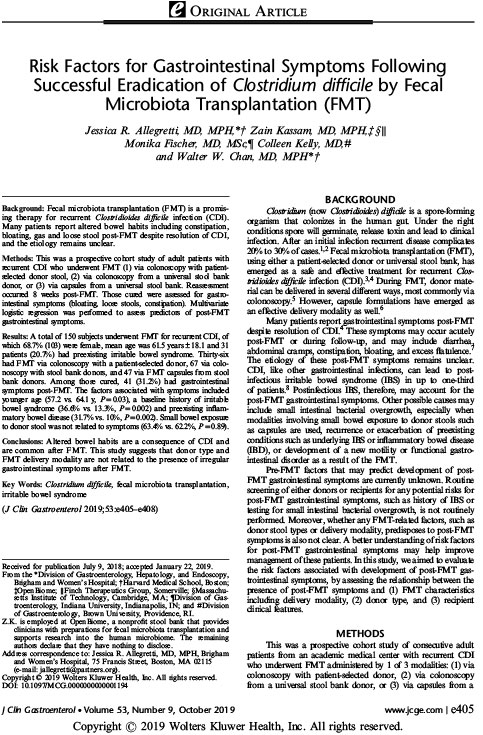
Background: Fecal microbiota transplantation (FMT) is a promising therapy for recurrent Clostridioides difficile infection (CDI).Many patients report altered bowel habits including constipation, bloating, gas and loose stool post-FMT despite resolution of CDI, and the etiology remains unclear.

Methods: This was a prospective cohort study of adult patients with recurrent CDI who underwent FMT (1) via colonoscopy with patientselected donor stool, (2) via colonoscopy from a universal stool bankdonor, or (3) via capsules from a universal stool bank. Reassessment occurred 8 weeks post-FMT. Those cured were assessed for gastrointestinal symptoms (bloating, loose stools, constipation). Multivariatelogistic regression was performed to assess predictors of post-FMT gastrointestinal symptoms.

Results: A total of 150 subjects underwent FMT for recurrent CDI, of which 68.7% (103) were female, mean age was 61.5 years±18.1 and 31 patients (20.7%) had preexisting irritable bowel syndrome. Thirty-six had FMT via colonoscopy with a patient-selected donor, 67 via colonoscopy with stool bank donors, and 47 via FMT capsules from stoolbank donors. Among those cured, 41 (31.2%) had gastrointestinal symptoms post-FMT. The factors associated with symptoms included younger age (57.2 vs. 64.1 y, P=0.03), a baseline history of irritable bowel syndrome (36.6% vs. 13.3%, P=0.002) and preexisting inflammatory bowel disease (31.7% vs. 10%, P=0.002). Small bowel exposureto donor stool was not related to symptoms (63.4% vs. 62.2%, P=0.89).

Conclusions: Altered bowel habits are a consequence of CDI and are common after FMT. This study suggests that donor type and FMT delivery modality are not related to the presence of irregular gastrointestinal symptoms after FMT.

Share

Modal body text goes here.

FocusOn logo
  • Articles
  • Multimedia
  • Blog
  • Resources
  • About FocusOn
  • Privacy Policy
  • Terms of Use

© 2026 Wolters Kluwer. All right reserved.

Your Privacy

To give you the best possible experience we use cookies and similar technologies. We use data collected through these technologies for various purposes, including to enhance website functionality, remember your preferences, show the most relevant content, and show the most useful ads. You can select your preferences by clicking the link. For more information, please review our Privacy and Cookie Policy.

|
|

Cookie Policy

Information about our use of cookies

Wolters Kluwer ("we" or "us") wants to inform you about the ways we process your personal information. In this Privacy & Cookie Notice we explain what personal information we collect, use and disclose.

Personal information means any data relating to an individual who can be identified, directly or indirectly, based on that information. This may include information such as names, contact details, (online) identification data, online identifiers, or other characteristics specific to that individual.

Read More