FocusOn Neurology
  • Gastrointestinal Resource Center
  • Highlights from ACG2024 - Focus on Ulcerative Colitis
  • Highlights from ACG2024 - Focus On Fatty Liver Disease
  • Inflammatory Bowel Disease
  • NASH Resource Center
  • Highlights from DDW 2025
  • Highlights from ACG 2025 - Focus on Ulcerative Colitis
  • Highlights from ACG 2025 - Focus on Metabolic Dysfunction–Associated Steatohepatitis (MASH)
  • Primary Biliary Cholangitis Knowledge Hub
  • C. difficile & Microbiome Therapeutics Knowledge Hub
  • Gastrointestinal Resource Center
  • Highlights from ACG2024 - Focus on Ulcerative Colitis
  • Highlights from ACG2024 - Focus On Fatty Liver Disease
  • Inflammatory Bowel Disease
  • NASH Resource Center
  • Highlights from DDW 2025
  • Highlights from ACG 2025 - Focus on Ulcerative Colitis
  • Highlights from ACG 2025 - Focus on Metabolic Dysfunction–Associated Steatohepatitis (MASH)
  • Primary Biliary Cholangitis Knowledge Hub
  • C. difficile & Microbiome Therapeutics Knowledge Hub

Advanced Search

Advanced Search

  • Featured:
  • Primary Biliary Cholangitis Knowledge Hub
  • C. difficile & Microbiome Therapeutics Knowledge Hub

Machine Learning Model Predicts Recurrent Clostridioides difficile Infection in Patients With Inflammatory Bowel Disease (Recur CDI-IBD)

April 2026
Share:
Back to C. difficile & Microbiome Therapeutics Knowledge Hub Peer-reviewed articles

Read Full Article

INTRODUCTION: 

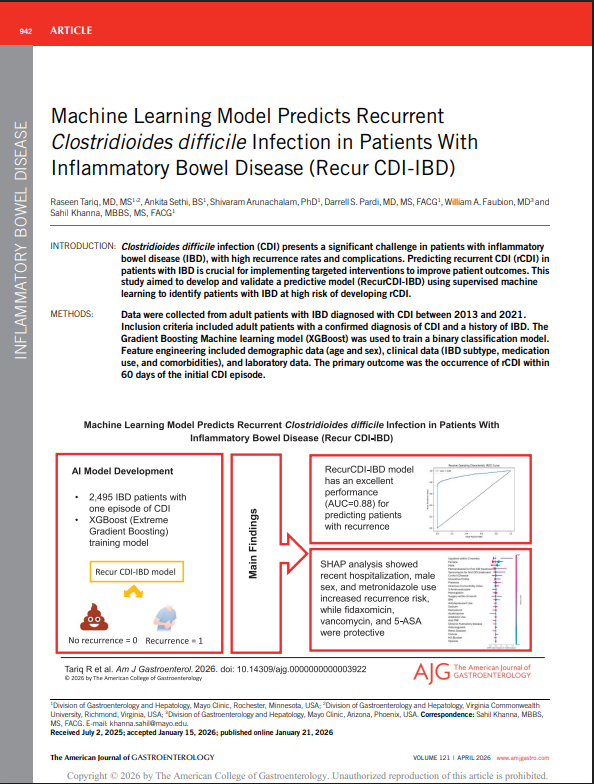
Clostridioides difficile infection (CDI) presents a significant challenge in patients with inflammatory bowel disease (IBD), with high recurrence rates and complications. Predicting recurrent CDI (rCDI) in patients with IBD is crucial for implementing targeted interventions to improve patient outcomes. This study aimed to develop and validate a predictive model (RecurCDI-IBD) using supervised machine learning to identify patients with IBD at high risk of developing rCDI.

METHODS: 

Data were collected from adult patients with IBD diagnosed with CDI between 2013 and 2021. Inclusion criteria included adult patients with a confirmed diagnosis of CDI and a history of IBD. The Gradient Boosting Machine learning model (XGBoost) was used to train a binary classification model. Feature engineering included demographic data (age and sex), clinical data (IBD subtype, medication use, and comorbidities), and laboratory data. The primary outcome was the occurrence of rCDI within 60 days of the initial CDI episode.

RESULTS: 

The RecurCDI-IBD model achieved an accuracy of 80.05% and an Area Under the Curve of 0.88 for predicting rCDI. Key predictive features included IBD subtype, sex, specific medications (such as steroids and anti-TNF agents), and comorbidities (such as chronic pulmonary and renal disease).

DISCUSSION: 

The RecurCDI-IBD model demonstrates good discriminatory ability with balanced precision and recall in identifying patients with IBD at higher risk for rCDI. These findings highlight the potential of data-driven approaches to support clinical risk assessment. Further studies incorporating larger and more diverse cohorts and prospective external validation are needed to confirm generalizability and optimize clinical applicability.

Share

Modal body text goes here.

FocusOn logo
  • Articles
  • Multimedia
  • Blog
  • Resources
  • About FocusOn
  • Privacy Policy
  • Terms of Use

© 2026 Wolters Kluwer. All right reserved.

Your Privacy

To give you the best possible experience we use cookies and similar technologies. We use data collected through these technologies for various purposes, including to enhance website functionality, remember your preferences, show the most relevant content, and show the most useful ads. You can select your preferences by clicking the link. For more information, please review our Privacy and Cookie Policy.

|
|

Cookie Policy

Information about our use of cookies

Wolters Kluwer ("we" or "us") wants to inform you about the ways we process your personal information. In this Privacy & Cookie Notice we explain what personal information we collect, use and disclose.

Personal information means any data relating to an individual who can be identified, directly or indirectly, based on that information. This may include information such as names, contact details, (online) identification data, online identifiers, or other characteristics specific to that individual.

Read More