FocusOn Neurology
  • Gastrointestinal Resource Center
  • Highlights from ACG2024 - Focus on Ulcerative Colitis
  • Highlights from ACG2024 - Focus On Fatty Liver Disease
  • Inflammatory Bowel Disease
  • NASH Resource Center
  • Highlights from DDW 2025
  • Highlights from ACG 2025 - Focus on Ulcerative Colitis
  • Highlights from ACG 2025 - Focus on Metabolic Dysfunction–Associated Steatohepatitis (MASH)
  • Primary Biliary Cholangitis Knowledge Hub
  • C. difficile & Microbiome Therapeutics Knowledge Hub
  • Gastrointestinal Resource Center
  • Highlights from ACG2024 - Focus on Ulcerative Colitis
  • Highlights from ACG2024 - Focus On Fatty Liver Disease
  • Inflammatory Bowel Disease
  • NASH Resource Center
  • Highlights from DDW 2025
  • Highlights from ACG 2025 - Focus on Ulcerative Colitis
  • Highlights from ACG 2025 - Focus on Metabolic Dysfunction–Associated Steatohepatitis (MASH)
  • Primary Biliary Cholangitis Knowledge Hub
  • C. difficile & Microbiome Therapeutics Knowledge Hub

Advanced Search

Advanced Search

  • Featured:
  • Primary Biliary Cholangitis Knowledge Hub
  • C. difficile & Microbiome Therapeutics Knowledge Hub

Fresh Versus Frozen Versus Lyophilized Fecal Microbiota Transplant for Recurrent Clostridium Difficile Infection

March 2023
Share:
Back to C. difficile & Microbiome Therapeutics Knowledge Hub Peer-reviewed articles

Read Full Article

Abstract

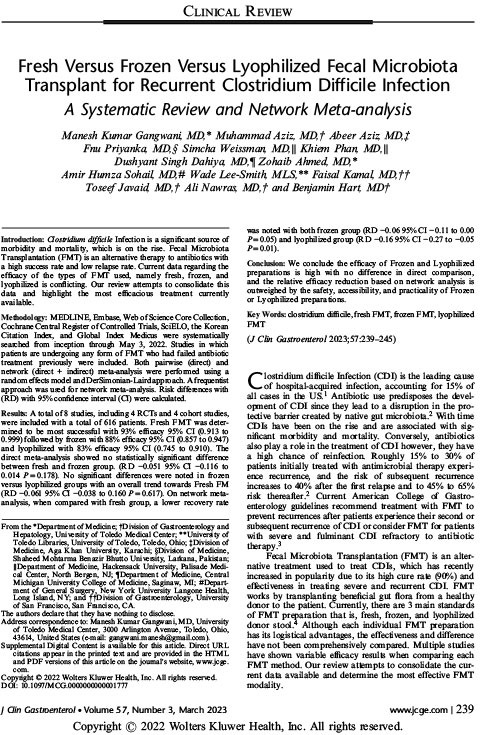
Introduction: Clostridium difficile Infection is a significant source of morbidity and mortality, which is on the rise. Fecal Microbiota Transplantation (FMT) is an alternative therapy to antibiotics with a high success rate and low relapse rate. Current data regarding the efficacy of the types of FMT used, namely fresh, frozen, andlyophilized is conflicting. Our review attempts to consolidate this data and highlight the most efficacious treatment currentlyavailable.

Methodology: MEDLINE, Embase, Web of Science Core Collection, Cochrane Central Register of Controlled Trials, SciELO, the Korean Citation Index, and Global Index Medicus were systematically searched from inception through May 3, 2022. Studies in which patients are undergoing any form of FMT who had failed antibiotic treatment previously were included. Both pairwise (direct) and network (direct + indirect) meta-analysis were performed using a random effectsmodel and DerSimonian-Laird approach.A frequentist approach was used for network meta-analysis. Risk differences with (RD) with 95% confidence interval (CI) were calculated.

Results: A total of 8 studies, including 4 RCTs and 4 cohort studies, were included with a total of 616 patients. Fresh FMT was determined to be most successful with 93% efficacy 95% CI (0.913 to0.999) followed by frozen with 88% efficacy 95% CI (0.857 to 0.947) and lyophilized with 83% efficacy 95% CI (0.745 to 0.910). The direct meta-analysis showed no statistically significant difference between fresh and frozen group. (RD −0.051 95% CI −0.116 to 0.014 P=0.178). No significant differences were noted in frozen versus lyophilized groups with an overall trend towards Fresh FM (RD −0.061 95% CI −0.038 to 0.160 P=0.617). On network metaanalysis, when compared with fresh group, a lower recovery ratewas noted with both frozen group (RD −0.06 95% CI −0.11 to 0.00 P=0.05) and lyophilized group (RD −0.16 95% CI −0.27 to −0.05 P=0.01).

Conclusion: We conclude the efficacy of Frozen and Lyophilized preparations is high with no difference in direct comparison, and the relative efficacy reduction based on network analysis is outweighed by the safety, accessibility, and practicality of Frozen or Lyophilized preparations.

Share

Modal body text goes here.

FocusOn logo
  • Articles
  • Multimedia
  • Blog
  • Resources
  • About FocusOn
  • Privacy Policy
  • Terms of Use

© 2026 Wolters Kluwer. All right reserved.

Your Privacy

To give you the best possible experience we use cookies and similar technologies. We use data collected through these technologies for various purposes, including to enhance website functionality, remember your preferences, show the most relevant content, and show the most useful ads. You can select your preferences by clicking the link. For more information, please review our Privacy and Cookie Policy.

|
|

Cookie Policy

Information about our use of cookies

Wolters Kluwer ("we" or "us") wants to inform you about the ways we process your personal information. In this Privacy & Cookie Notice we explain what personal information we collect, use and disclose.

Personal information means any data relating to an individual who can be identified, directly or indirectly, based on that information. This may include information such as names, contact details, (online) identification data, online identifiers, or other characteristics specific to that individual.

Read More