FocusOn Neurology
  • Gastrointestinal Resource Center
  • Highlights from ACG2024 - Focus on Ulcerative Colitis
  • Highlights from ACG2024 - Focus On Fatty Liver Disease
  • Inflammatory Bowel Disease
  • NASH Resource Center
  • Highlights from DDW 2025
  • Highlights from ACG 2025 - Focus on Ulcerative Colitis
  • Highlights from ACG 2025 - Focus on Metabolic Dysfunction–Associated Steatohepatitis (MASH)
  • Primary Biliary Cholangitis Knowledge Hub
  • C. difficile & Microbiome Therapeutics Knowledge Hub
  • Gastrointestinal Resource Center
  • Highlights from ACG2024 - Focus on Ulcerative Colitis
  • Highlights from ACG2024 - Focus On Fatty Liver Disease
  • Inflammatory Bowel Disease
  • NASH Resource Center
  • Highlights from DDW 2025
  • Highlights from ACG 2025 - Focus on Ulcerative Colitis
  • Highlights from ACG 2025 - Focus on Metabolic Dysfunction–Associated Steatohepatitis (MASH)
  • Primary Biliary Cholangitis Knowledge Hub
  • C. difficile & Microbiome Therapeutics Knowledge Hub

Advanced Search

Advanced Search

  • Featured:
  • Primary Biliary Cholangitis Knowledge Hub
  • C. difficile & Microbiome Therapeutics Knowledge Hub

Emergency department eosinophil counts and mortality in Clostridium difficile: a multihospital retrospective cohort study

June 2025
Share:
Back to C. difficile & Microbiome Therapeutics Knowledge Hub Peer-reviewed articles

Read Full Article

Abstract

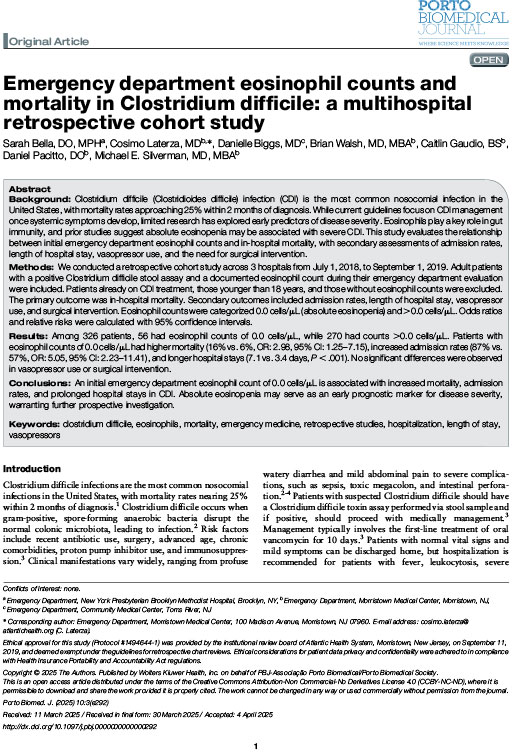
Background: Clostridium difficile (Clostridioides difficile) infection (CDI) is the most common nosocomial infection in the United States, with mortality rates approaching 25% within 2 months of diagnosis. While current guidelines focus on CDI management once systemic symptoms develop, limited research has explored early predictors of disease severity. Eosinophils play a key role in gut immunity, and prior studies suggest absolute eosinopenia may be associated with severe CDI. This study evaluates the relationship between initial emergency department eosinophil counts and in-hospital mortality, with secondary assessments of admission rates, length of hospital stay, vasopressor use, and the need for surgical intervention.

Methods: We conducted a retrospective cohort study across 3 hospitals from July 1, 2018, to September 1, 2019. Adult patients with a positive Clostridium difficile stool assay and a documented eosinophil count during their emergency department evaluation were included. Patients already on CDI treatment, those younger than 18 years, and those without eosinophil counts were excluded.The primary outcome was in-hospital mortality. Secondary outcomes included admission rates, length of hospital stay, vasopressor use, and surgical intervention. Eosinophil counts were categorized 0.0 cells/mL (absolute eosinopenia) and.0.0 cells/mL. Odds ratios and relative risks were calculated with 95% confidence intervals.

Results: Among 326 patients, 56 had eosinophil counts of 0.0 cells/mL, while 270 had counts .0.0 cells/mL. Patients with eosinophil counts of 0.0 cells/mL had higher mortality (16% vs. 6%, OR: 2.98, 95% CI: 1.25–7.15), increased admission rates (87% vs.57%, OR: 5.05, 95% CI: 2.23–11.41), and longer hospital stays (7.1 vs. 3.4 days, P,.001). No significant differences were observed in vasopressor use or surgical intervention.

Conclusions: An initial emergency department eosinophil count of 0.0 cells/mL is associated with increased mortality, admission rates, and prolonged hospital stays in CDI. Absolute eosinopenia may serve as an early prognostic marker for disease severity, warranting further prospective investigation.

Share

Modal body text goes here.

FocusOn logo
  • Articles
  • Multimedia
  • Blog
  • Resources
  • About FocusOn
  • Privacy Policy
  • Terms of Use

© 2026 Wolters Kluwer. All right reserved.

Your Privacy

To give you the best possible experience we use cookies and similar technologies. We use data collected through these technologies for various purposes, including to enhance website functionality, remember your preferences, show the most relevant content, and show the most useful ads. You can select your preferences by clicking the link. For more information, please review our Privacy and Cookie Policy.

|
|

Cookie Policy

Information about our use of cookies

Wolters Kluwer ("we" or "us") wants to inform you about the ways we process your personal information. In this Privacy & Cookie Notice we explain what personal information we collect, use and disclose.

Personal information means any data relating to an individual who can be identified, directly or indirectly, based on that information. This may include information such as names, contact details, (online) identification data, online identifiers, or other characteristics specific to that individual.

Read More