FocusOn Neurology
  • Gastrointestinal Resource Center
  • Highlights from ACG2024 - Focus on Ulcerative Colitis
  • Highlights from ACG2024 - Focus On Fatty Liver Disease
  • Inflammatory Bowel Disease
  • NASH Resource Center
  • Highlights from DDW 2025
  • Highlights from ACG 2025 - Focus on Ulcerative Colitis
  • Highlights from ACG 2025 - Focus on Metabolic Dysfunction–Associated Steatohepatitis (MASH)
  • Primary Biliary Cholangitis Knowledge Hub
  • C. difficile & Microbiome Therapeutics Knowledge Hub
  • Gastrointestinal Resource Center
  • Highlights from ACG2024 - Focus on Ulcerative Colitis
  • Highlights from ACG2024 - Focus On Fatty Liver Disease
  • Inflammatory Bowel Disease
  • NASH Resource Center
  • Highlights from DDW 2025
  • Highlights from ACG 2025 - Focus on Ulcerative Colitis
  • Highlights from ACG 2025 - Focus on Metabolic Dysfunction–Associated Steatohepatitis (MASH)
  • Primary Biliary Cholangitis Knowledge Hub
  • C. difficile & Microbiome Therapeutics Knowledge Hub

Advanced Search

Advanced Search

  • Featured:
  • Primary Biliary Cholangitis Knowledge Hub
  • C. difficile & Microbiome Therapeutics Knowledge Hub

Dynamics in Circulating Immune Cell Subsets After Fecal Microbiota Transplantation for Recurrent Clostridioides difficile Infection

February 2026
Share:
Back to C. difficile & Microbiome Therapeutics Knowledge Hub Peer-reviewed articles

Read Full Article

INTRODUCTION: 

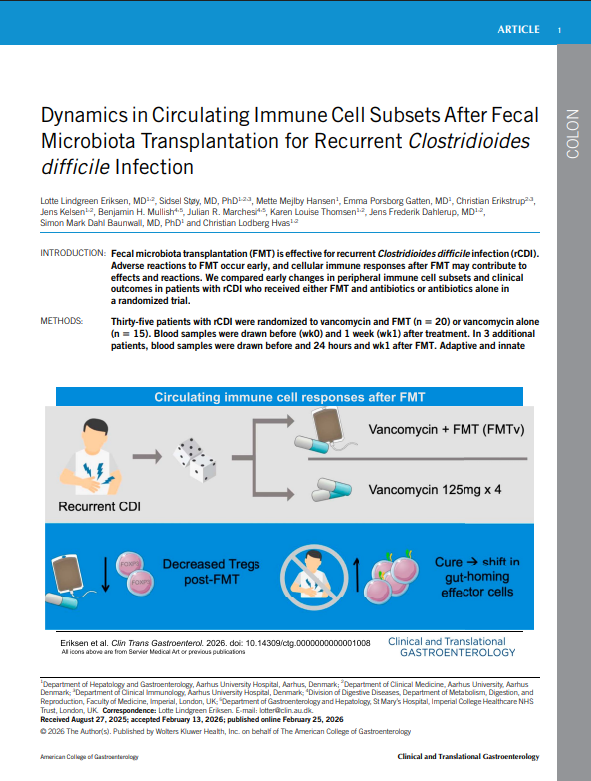
Fecal microbiota transplantation (FMT) is effective for recurrent Clostridioides difficile infection (rCDI). Adverse reactions to FMT occur early, and cellular immune responses after FMT may contribute to effects and reactions. We compared early changes in peripheral immune cell subsets and clinical outcomes in patients with rCDI who received either FMT and antibiotics or antibiotics alone in a randomized trial.

METHODS: 

Thirty-five patients with rCDI were randomized to vancomycin and FMT (n = 20) or vancomycin alone (n = 15). Blood samples were drawn before (wk0) and 1 week (wk1) after treatment. In 3 additional patients, blood samples were drawn before and 24 hours and wk1 after FMT. Adaptive and innate immune cell subsets and gut-homing memory (CD45RO+integrinβ7+) and effector (CD45RO-integrinβ7+) T cells were analyzed by flow cytometry.

RESULTS: 

FMT induced subtle changes in immune cell subsets with no clear pattern from wk0 to wk1. The Treg fraction tended to decrease after FMT, and a similar decrease at 24 hours indicated rapid T regulatory cells dynamics. Natural killer T (NKT) cells increased during the first 24 hours and returned to baseline level at wk1. Regardless of FMT, patients with clinical resolution from rCDI had a decrease in nonclassical monocytes and a shift in gut-homing memory to effector cells at wk1.

DISCUSSION: 

In rCDI, FMT induced subtle and transient dynamics in peripheral immune cell subsets. T regulatory cells and NKT cells seemed responsive and should be further studied. Cure of Clostridioides difficile infection may be associated with an increase in circulating gut-homing T cells.

Share

Modal body text goes here.

FocusOn logo
  • Articles
  • Multimedia
  • Blog
  • Resources
  • About FocusOn
  • Privacy Policy
  • Terms of Use

© 2026 Wolters Kluwer. All right reserved.

Your Privacy

To give you the best possible experience we use cookies and similar technologies. We use data collected through these technologies for various purposes, including to enhance website functionality, remember your preferences, show the most relevant content, and show the most useful ads. You can select your preferences by clicking the link. For more information, please review our Privacy and Cookie Policy.

|
|

Cookie Policy

Information about our use of cookies

Wolters Kluwer ("we" or "us") wants to inform you about the ways we process your personal information. In this Privacy & Cookie Notice we explain what personal information we collect, use and disclose.

Personal information means any data relating to an individual who can be identified, directly or indirectly, based on that information. This may include information such as names, contact details, (online) identification data, online identifiers, or other characteristics specific to that individual.

Read More