FocusOn Neurology
  • Gastrointestinal Resource Center
  • Highlights from ACG2024 - Focus on Ulcerative Colitis
  • Highlights from ACG2024 - Focus On Fatty Liver Disease
  • Inflammatory Bowel Disease
  • NASH Resource Center
  • Highlights from DDW 2025
  • Highlights from ACG 2025 - Focus on Ulcerative Colitis
  • Highlights from ACG 2025 - Focus on Metabolic Dysfunction–Associated Steatohepatitis (MASH)
  • Primary Biliary Cholangitis Knowledge Hub
  • C. difficile & Microbiome Therapeutics Knowledge Hub
  • Gastrointestinal Resource Center
  • Highlights from ACG2024 - Focus on Ulcerative Colitis
  • Highlights from ACG2024 - Focus On Fatty Liver Disease
  • Inflammatory Bowel Disease
  • NASH Resource Center
  • Highlights from DDW 2025
  • Highlights from ACG 2025 - Focus on Ulcerative Colitis
  • Highlights from ACG 2025 - Focus on Metabolic Dysfunction–Associated Steatohepatitis (MASH)
  • Primary Biliary Cholangitis Knowledge Hub
  • C. difficile & Microbiome Therapeutics Knowledge Hub

Advanced Search

Advanced Search

  • Featured:
  • Primary Biliary Cholangitis Knowledge Hub
  • C. difficile & Microbiome Therapeutics Knowledge Hub

Diagnosis and Management of Clostridioides difficile

March 2026
Share:
Back to C. difficile & Microbiome Therapeutics Knowledge Hub Peer-reviewed articles

Read Full Article

ABSTRACT

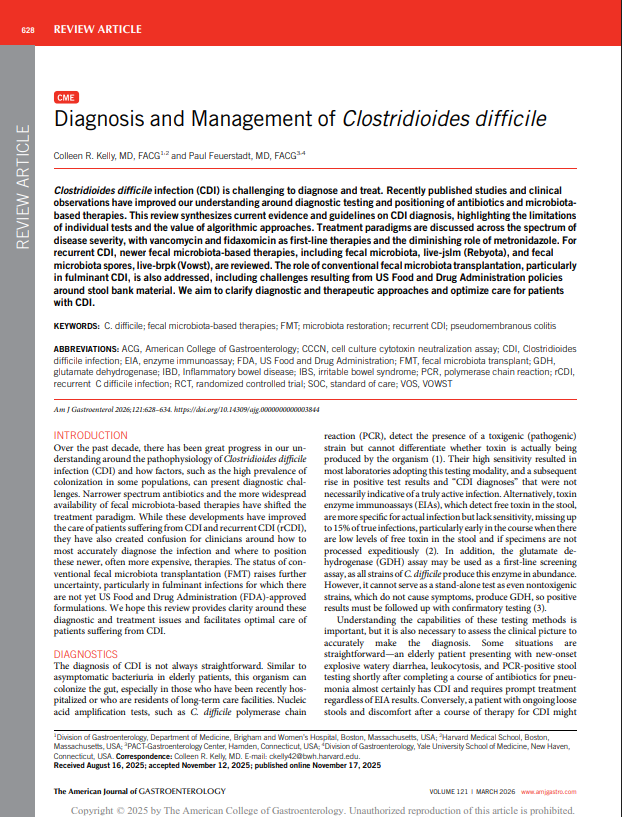
Clostridioides difficile infection (CDI) is challenging to diagnose and treat. Recently published studies and clinical observations have improved our understanding around diagnostic testing and positioning of antibiotics and microbiota-based therapies. This review synthesizes current evidence and guidelines on CDI diagnosis, highlighting the limitations of individual tests and the value of algorithmic approaches. Treatment paradigms are discussed across the spectrum of disease severity, with vancomycin and fidaxomicin as first-line therapies and the diminishing role of metronidazole. For recurrent CDI, newer fecal microbiota-based therapies, including fecal microbiota, live-jslm (Rebyota), and fecal microbiota spores, live-brpk (Vowst), are reviewed. The role of conventional fecal microbiota transplantation, particularly in fulminant CDI, is also addressed, including challenges resulting from US Food and Drug Administration policies around stool bank material. We aim to clarify diagnostic and therapeutic approaches and optimize care for patients with CDI.

Share

Modal body text goes here.

FocusOn logo
  • Articles
  • Multimedia
  • Blog
  • Resources
  • About FocusOn
  • Privacy Policy
  • Terms of Use

© 2026 Wolters Kluwer. All right reserved.

Your Privacy

To give you the best possible experience we use cookies and similar technologies. We use data collected through these technologies for various purposes, including to enhance website functionality, remember your preferences, show the most relevant content, and show the most useful ads. You can select your preferences by clicking the link. For more information, please review our Privacy and Cookie Policy.

|
|

Cookie Policy

Information about our use of cookies

Wolters Kluwer ("we" or "us") wants to inform you about the ways we process your personal information. In this Privacy & Cookie Notice we explain what personal information we collect, use and disclose.

Personal information means any data relating to an individual who can be identified, directly or indirectly, based on that information. This may include information such as names, contact details, (online) identification data, online identifiers, or other characteristics specific to that individual.

Read More