FocusOn Neurology
  • Gastrointestinal Resource Center
  • Highlights from ACG2024 - Focus on Ulcerative Colitis
  • Highlights from ACG2024 - Focus On Fatty Liver Disease
  • Inflammatory Bowel Disease
  • NASH Resource Center
  • Highlights from DDW 2025
  • Highlights from ACG 2025 - Focus on Ulcerative Colitis
  • Highlights from ACG 2025 - Focus on Metabolic Dysfunction–Associated Steatohepatitis (MASH)
  • Primary Biliary Cholangitis Knowledge Hub
  • C. difficile & Microbiome Therapeutics Knowledge Hub
  • Gastrointestinal Resource Center
  • Highlights from ACG2024 - Focus on Ulcerative Colitis
  • Highlights from ACG2024 - Focus On Fatty Liver Disease
  • Inflammatory Bowel Disease
  • NASH Resource Center
  • Highlights from DDW 2025
  • Highlights from ACG 2025 - Focus on Ulcerative Colitis
  • Highlights from ACG 2025 - Focus on Metabolic Dysfunction–Associated Steatohepatitis (MASH)
  • Primary Biliary Cholangitis Knowledge Hub
  • C. difficile & Microbiome Therapeutics Knowledge Hub

Advanced Search

Advanced Search

  • Featured:
  • Primary Biliary Cholangitis Knowledge Hub
  • C. difficile & Microbiome Therapeutics Knowledge Hub

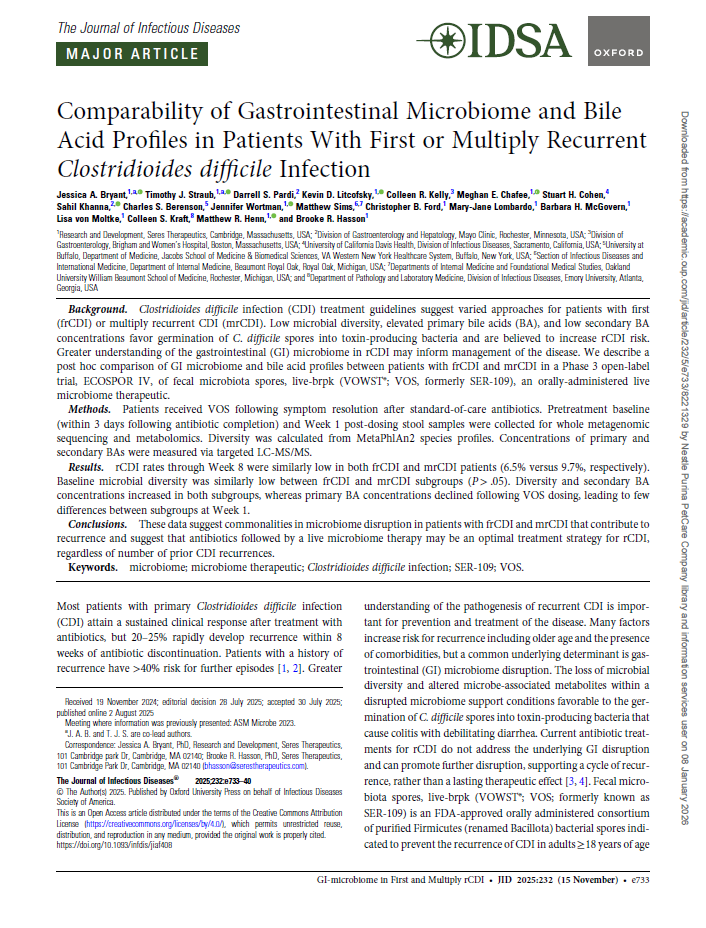
Comparability of Gastrointestinal Microbiome and Bile Acid Profiles in Patients With First or Multiply Recurrent Clostridioides difficile Infection

November 2025
Share:
Back to C. difficile & Microbiome Therapeutics Knowledge Hub Peer-reviewed articles

Read Full Article

Background. Clostridioides difficile infection (CDI) treatment guidelines suggest varied approaches for patients with first (frCDI) or multiply recurrent CDI (mrCDI). Low microbial diversity, elevated primary bile acids (BA), and low secondary BA concentrations favor germination of C. difficile spores into toxin-producing bacteria and are believed to increase rCDI risk. Greater understanding of the gastrointestinal (GI) microbiome in rCDI may inform management of the disease. We describe a post hoc comparison of GI microbiome and bile acid profiles between patients with frCDI and mrCDI in a Phase 3 open-label trial, ECOSPOR IV, of fecal microbiota spores, live-brpk (VOWST®; VOS, formerly SER-109), an orally-administered live microbiome therapeutic.

Methods. Patients received VOS following symptom resolution after standard-of-care antibiotics. Pretreatment baseline (within 3 days following antibiotic completion) and Week 1 post-dosing stool samples were collected for whole metagenomic sequencing and metabolomics. Diversity was calculated from MetaPhlAn2 species profiles. Concentrations of primary and secondary BAs were measured via targeted LC-MS/MS.

Results. rCDI rates through Week 8 were similarly low in both frCDI and mrCDI patients (6.5% versus 9.7%, respectively). Baseline microbial diversity was similarly low between frCDI and mrCDI subgroups (P > .05). Diversity and secondary BA concentrations increased in both subgroups, whereas primary BA concentrations declined following VOS dosing, leading to few differences between subgroups at Week 1.

Conclusions. These data suggest commonalities in microbiome disruption in patients with frCDI and mrCDI that contribute to recurrence and suggest that antibiotics followed by a live microbiome therapy may be an optimal treatment strategy for rCDI, regardless of number of prior CDI recurrences.

Keywords. microbiome; microbiome therapeutic; Clostridioides difficile infection; SER-109; VOS.

To view a copy of this licence, visit http://creativecommons.org/licenses/by/4.0/

Share

Modal body text goes here.

FocusOn logo
  • Articles
  • Multimedia
  • Blog
  • Resources
  • About FocusOn
  • Privacy Policy
  • Terms of Use

© 2026 Wolters Kluwer. All right reserved.

Your Privacy

To give you the best possible experience we use cookies and similar technologies. We use data collected through these technologies for various purposes, including to enhance website functionality, remember your preferences, show the most relevant content, and show the most useful ads. You can select your preferences by clicking the link. For more information, please review our Privacy and Cookie Policy.

|
|

Cookie Policy

Information about our use of cookies

Wolters Kluwer ("we" or "us") wants to inform you about the ways we process your personal information. In this Privacy & Cookie Notice we explain what personal information we collect, use and disclose.

Personal information means any data relating to an individual who can be identified, directly or indirectly, based on that information. This may include information such as names, contact details, (online) identification data, online identifiers, or other characteristics specific to that individual.

Read More