FocusOn Neurology
  • Gastrointestinal Resource Center
  • Highlights from ACG2024 - Focus on Ulcerative Colitis
  • Highlights from ACG2024 - Focus On Fatty Liver Disease
  • Inflammatory Bowel Disease
  • NASH Resource Center
  • Highlights from DDW 2025
  • Highlights from ACG 2025 - Focus on Ulcerative Colitis
  • Highlights from ACG 2025 - Focus on Metabolic Dysfunction–Associated Steatohepatitis (MASH)
  • Primary Biliary Cholangitis Knowledge Hub
  • C. difficile & Microbiome Therapeutics Knowledge Hub
  • Highlights from DDW 2026
  • Gastrointestinal Resource Center
  • Highlights from ACG2024 - Focus on Ulcerative Colitis
  • Highlights from ACG2024 - Focus On Fatty Liver Disease
  • Inflammatory Bowel Disease
  • NASH Resource Center
  • Highlights from DDW 2025
  • Highlights from ACG 2025 - Focus on Ulcerative Colitis
  • Highlights from ACG 2025 - Focus on Metabolic Dysfunction–Associated Steatohepatitis (MASH)
  • Primary Biliary Cholangitis Knowledge Hub
  • C. difficile & Microbiome Therapeutics Knowledge Hub
  • Highlights from DDW 2026

Advanced Search

Advanced Search

  • Featured:
  • Primary Biliary Cholangitis Knowledge Hub
  • C. difficile & Microbiome Therapeutics Knowledge Hub
  • Highlights from DDW 2026

Clostridioides difficile: A suspected pro-carcinogenic bacterium for gastrointestinal tumors

January 2026
Share:
Back to C. difficile & Microbiome Therapeutics Knowledge Hub Peer-reviewed articles

Read Full Article

Abstract

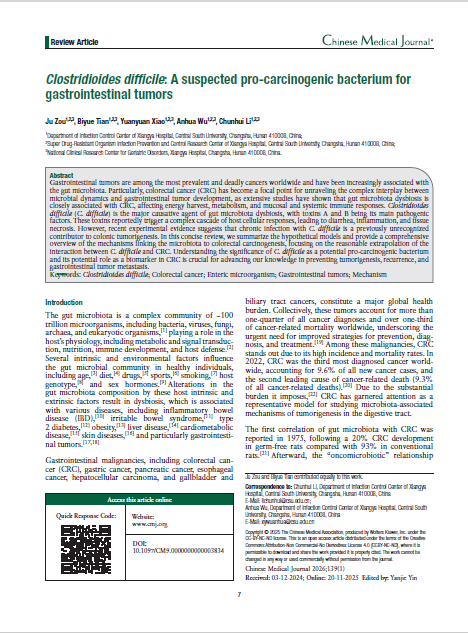
Gastrointestinal tumors are among the most prevalent and deadly cancers worldwide and have been increasingly associated with the gut microbiota. Particularly, colorectal cancer (CRC) has become a focal point for unraveling the complex interplay between microbial dynamics and gastrointestinal tumor development, as extensive studies have shown that gut microbiota dysbiosis is closely associated with CRC, affecting energy harvest, metabolism, and mucosal and systemic immune responses. Clostridioides difficile (C. difficile) is the major causative agent of gut microbiota dysbiosis, with toxins A and B being its main pathogenic factors. These toxins reportedly trigger a complex cascade of host cellular responses, leading to diarrhea, inflammation, and tissue necrosis. However, recent experimental evidence suggests that chronic infection with C. difficile is a previously unrecognized contributor to colonic tumorigenesis. In this concise review, we summarize the hypothetical models and provide a comprehensive overview of the mechanisms linking the microbiota to colorectal carcinogenesis, focusing on the reasonable extrapolation of the interaction between C. difficile and CRC. Understanding the significance of C. difficile as a potential pro-carcinogenic bacterium and its potential role as a biomarker in CRC is crucial for advancing our knowledge in preventing tumorigenesis, recurrence, and gastrointestinal tumor metastasis.

Share

Modal body text goes here.

FocusOn logo
  • Articles
  • Multimedia
  • Blog
  • Resources
  • About FocusOn
  • Privacy Policy
  • Terms of Use

© 2026 Wolters Kluwer. All right reserved.

Your Privacy

To give you the best possible experience we use cookies and similar technologies. We use data collected through these technologies for various purposes, including to enhance website functionality, remember your preferences, show the most relevant content, and show the most useful ads. You can select your preferences by clicking the link. For more information, please review our Privacy and Cookie Policy.

|
|

Cookie Policy

Information about our use of cookies

Wolters Kluwer ("we" or "us") wants to inform you about the ways we process your personal information. In this Privacy & Cookie Notice we explain what personal information we collect, use and disclose.

Personal information means any data relating to an individual who can be identified, directly or indirectly, based on that information. This may include information such as names, contact details, (online) identification data, online identifiers, or other characteristics specific to that individual.

Read More