FocusOn Neurology
  • Gastrointestinal Resource Center
  • Highlights from ACG2024 - Focus on Ulcerative Colitis
  • Highlights from ACG2024 - Focus On Fatty Liver Disease
  • Inflammatory Bowel Disease
  • NASH Resource Center
  • Highlights from DDW 2025
  • Highlights from ACG 2025 - Focus on Ulcerative Colitis
  • Highlights from ACG 2025 - Focus on Metabolic Dysfunction–Associated Steatohepatitis (MASH)
  • Primary Biliary Cholangitis Knowledge Hub
  • C. difficile & Microbiome Therapeutics Knowledge Hub
  • Gastrointestinal Resource Center
  • Highlights from ACG2024 - Focus on Ulcerative Colitis
  • Highlights from ACG2024 - Focus On Fatty Liver Disease
  • Inflammatory Bowel Disease
  • NASH Resource Center
  • Highlights from DDW 2025
  • Highlights from ACG 2025 - Focus on Ulcerative Colitis
  • Highlights from ACG 2025 - Focus on Metabolic Dysfunction–Associated Steatohepatitis (MASH)
  • Primary Biliary Cholangitis Knowledge Hub
  • C. difficile & Microbiome Therapeutics Knowledge Hub

Advanced Search

Advanced Search

  • Featured:
  • Primary Biliary Cholangitis Knowledge Hub
  • C. difficile & Microbiome Therapeutics Knowledge Hub

Bacterial and Fungal Gut Dysbiosis and Clostridium difficile in COVID-19

April 2022
Share:
Back to C. difficile & Microbiome Therapeutics Knowledge Hub Peer-reviewed articles

Read Full Article

Abstract

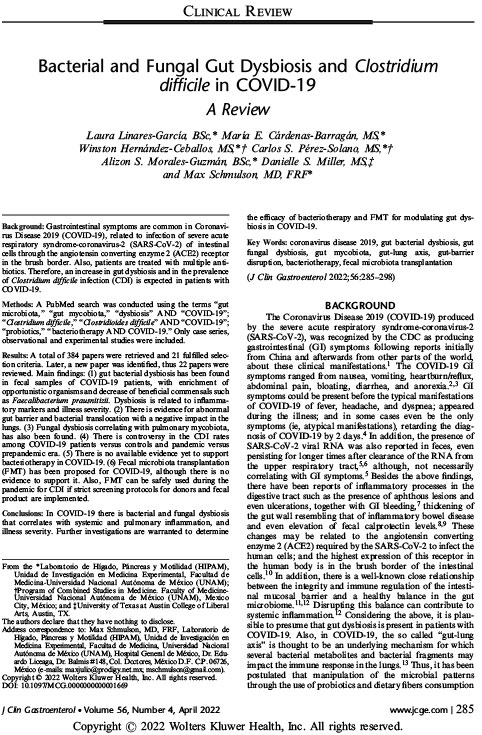
Background: Gastrointestinal symptoms are common in Coronavirus Disease 2019 (COVID-19), related to infection of severe acute respiratory syndrome-coronavirus-2 (SARS-CoV-2) of intestinal cells through the angiotensin converting enzyme 2 (ACE2) receptor in the brush border. Also, patients are treated with multiple antibiotics.Therefore, an increase in gut dysbiosis and in the prevalence of Clostridium difficile infection (CDI) is expected in patients with COVID-19.

Methods: A PubMed search was conducted using the terms “gut microbiota,” “gut mycobiota,” “dysbiosis” AND “COVID-19”; “Clostridium difficile,” “Clostridioides difficile” AND “COVID-19”; “probiotics,” “bacteriotherapy AND COVID-19.” Only case

Results: A total of 384 papers were retrieved and 21 fulfilled selection criteria. Later, a new paper was identified, thus 22 papers were reviewed. Main findings: (1) gut bacterial dysbiosis has been found in fecal samples of COVID-19 patients, with enrichment ofopportunistic organisms and decrease of beneficial commensals such as Faecalibacterium prausnitizii. Dysbiosis is related to inflammatory markers and illness severity. (2) There is evidence for abnormal gut barrier and bacterial translocation with a negative impact in the lungs. (3) Fungal dysbiosis correlating with pulmonary mycobiota, has also been found. (4) There is controversy in the CDI rates among COVID-19 patients versus controls and pandemic versusprepandemic era. (5) There is no available evidence yet to support bacteriotherapy in COVID-19. (6) Fecal microbiota transplantation (FMT) has been proposed for COVID-19, although there is noevidence to support it. Also, FMT can be safely used during the pandemic for CDI if strict screening protocols for donors and fecal product are implemented.

Conclusions: In COVID-19 there is bacterial and fungal dysbiosis that correlates with systemic and pulmonary inflammation, and illness severity. Further investigations are warranted to determine the efficacy of bacteriotherapy and FMT for modulating gut dysbiosis in COVID-19.

Share

Modal body text goes here.

FocusOn logo
  • Articles
  • Multimedia
  • Blog
  • Resources
  • About FocusOn
  • Privacy Policy
  • Terms of Use

© 2026 Wolters Kluwer. All right reserved.

Your Privacy

To give you the best possible experience we use cookies and similar technologies. We use data collected through these technologies for various purposes, including to enhance website functionality, remember your preferences, show the most relevant content, and show the most useful ads. You can select your preferences by clicking the link. For more information, please review our Privacy and Cookie Policy.

|
|

Cookie Policy

Information about our use of cookies

Wolters Kluwer ("we" or "us") wants to inform you about the ways we process your personal information. In this Privacy & Cookie Notice we explain what personal information we collect, use and disclose.

Personal information means any data relating to an individual who can be identified, directly or indirectly, based on that information. This may include information such as names, contact details, (online) identification data, online identifiers, or other characteristics specific to that individual.

Read More